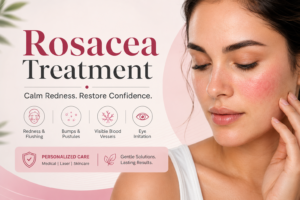
Facial redness is often dismissed as sensitive skin, sun exposure or simply a tendency to blush easily. But when redness keeps returning, becomes more persistent, or is accompanied by burning, visible blood vessels or acne-like bumps, there may be more to it than sensitive skin.
One possible cause is rosacea.
Rosacea is a chronic inflammatory skin condition that primarily affects the face. It can cause recurrent flushing, persistent facial redness, visible small blood vessels, acne-like bumps and pustules, and sometimes changes involving the eyes or thickening of the skin. Rosacea can occur across different skin tones, although the way it appears may vary. In darker skin tones, obvious redness may be less noticeable, while burning, warmth, swelling or brown-violet discoloration may be more apparent.
The good news is that rosacea can usually be managed effectively with an individualized treatment plan. There is currently no treatment that permanently cures rosacea in every patient, but appropriate medical treatment can reduce flare-ups, control inflammation, improve persistent redness and help prevent the condition from becoming more difficult to manage.
The important point is that rosacea is not the same as acne, an allergy or ordinary sensitive skin. Treatment therefore needs to be based on the specific features of the condition.
This detailed guide explains rosacea treatment, its symptoms and triggers, different types of rosacea, available medicines, laser and light-based treatments, skincare, and when you should consult a dermatologist.
What Is Rosacea?
Rosacea is a chronic inflammatory skin disorder that most commonly affects the central face, particularly the cheeks, nose, chin and forehead.
It can begin subtly.
A person may initially notice that their face becomes red after exercising, eating spicy food, drinking a hot beverage, spending time in the sun or feeling embarrassed. Over time, these episodes of flushing may become more frequent and may last longer.
In some people, redness eventually becomes persistent.
Small visible blood vessels may appear. Acne-like bumps or pustules may develop. The skin can feel warm, sensitive, tight, itchy or irritated.
Rosacea can also affect the eyes, a condition known as ocular rosacea.
The appearance of rosacea is not identical in every patient. Dermatologists increasingly focus on the individual signs and symptoms present rather than treating every patient according to a rigid subtype.
This is important because one person may primarily have persistent facial redness, while another may have inflammatory bumps and pustules, and another may have prominent blood vessels or eye symptoms.
The treatment needs to address the features that are actually present.
What Are the Symptoms of Rosacea?
Rosacea can produce a combination of symptoms. Some people have only one or two features, while others experience several.
Common symptoms include:
- Frequent facial flushing
- Persistent facial redness
- Burning or warmth
- Stinging or sensitive skin
- Visible small blood vessels
- Acne-like bumps
- Pus-filled pustules
- Dry or rough skin
- Facial swelling
- Eye irritation
- Red or bloodshot eyes
- Eyelid swelling
- Thickening of facial skin in advanced cases
The redness may initially come and go. As the condition progresses, however, some patients develop longer-lasting discoloration.
The American Academy of Dermatology describes flushing, persistent facial color changes, acne-like breakouts and visible blood vessels as common manifestations of rosacea. Eye involvement and skin thickening can also occur.
Rosacea in Different Skin Tones
One important aspect of diagnosing rosacea is recognizing that it does not always look the same on every complexion.
In lighter skin, rosacea is often associated with obvious pink or red facial discoloration.
In medium to darker skin tones, the redness may be less visually obvious. Some patients may instead notice:
- Brownish or violet discoloration
- Warmth
- Burning
- Stinging
- Swelling
- Acne-like bumps
- Skin sensitivity
This can sometimes delay diagnosis.
Rosacea should therefore not be diagnosed—or ruled out—simply by looking for bright red cheeks.
A dermatologist considers the complete clinical picture.
What Causes Rosacea?
The exact cause of rosacea is not fully understood.
It is believed to involve a combination of factors affecting the skin’s immune response, blood vessels, nervous system signalling, skin barrier and other biological mechanisms.
Research has also investigated the role of microorganisms that live naturally on the skin, including Demodex mites, as well as other inflammatory pathways.
Rosacea is therefore more complicated than simply having “sensitive skin.”
A person may have a genetic tendency towards rosacea, while environmental factors and individual triggers influence how frequently the condition flares.
The important practical point is that there is no single cause that applies to every patient.
Common Rosacea Triggers
Although the underlying cause of rosacea is complex, many patients notice that certain situations make their symptoms worse.
Common triggers include:
- Sun exposure
- Heat
- Hot weather
- Sudden temperature changes
- Spicy foods
- Hot beverages
- Alcohol
- Emotional stress
- Intense exercise
- Very hot baths or showers
- Cold or windy weather
- Certain skincare products
- Harsh exfoliation
- Fragranced products
Triggers are highly individual.
Something that causes a flare in one person may have no effect on another.
The American Academy of Dermatology recommends identifying individual triggers rather than assuming that every patient needs to avoid exactly the same foods or activities. Keeping a record of flare-ups can help identify personal patterns.
Is Rosacea the Same as Acne?
No.
Rosacea and acne can sometimes look similar, particularly when inflammatory bumps and pustules are present.
But they are different conditions.
Acne commonly involves blackheads, whiteheads, clogged pores and inflammatory lesions. Rosacea can produce acne-like bumps but typically occurs alongside facial redness, flushing, burning or visible blood vessels.
The distinction matters because some acne treatments can be irritating to rosacea-prone skin.
For example, aggressive exfoliation, strong acne products or frequent use of irritating active ingredients may worsen sensitivity.
If you have persistent facial redness along with acne-like bumps, it is better to obtain a proper diagnosis instead of assuming that you have conventional acne.
Types and Patterns of Rosacea
Rosacea can present in several different ways.
Persistent Facial Redness and Flushing
Some patients primarily experience recurrent flushing that gradually becomes more persistent.
The face may appear red or discolored, particularly around the cheeks and central face.
Visible Blood Vessels
Small blood vessels may become visible on the cheeks, nose or other areas of the face.
These are known as telangiectasia.
Once visible vessels have developed, skincare alone may not make them disappear. Laser or light-based treatments may be considered in appropriate patients.
Papules and Pustules
Some patients develop small inflammatory bumps and pustules.
This pattern can resemble acne and is commonly referred to as papulopustular rosacea.
Topical and oral anti-inflammatory treatments may be used depending on the severity.
Phymatous Changes
In some patients, particularly when rosacea has been present for a long time, the skin can become thicker.
When this affects the nose, it is known as rhinophyma.
Early assessment is important because established tissue thickening may require procedural treatment in addition to medical management.
Ocular Rosacea
Rosacea can also affect the eyes.
Symptoms may include:
- Dry eyes
- Burning
- Grittiness
- Redness
- Watery eyes
- Eyelid swelling
- Crusting around the eyelashes
- Light sensitivity
Ocular symptoms should not be ignored. In severe cases, untreated ocular rosacea can affect the eye and potentially threaten vision.
How Is Rosacea Diagnosed?
There is no single blood test or laboratory test that confirms rosacea.
A dermatologist generally diagnoses it by examining the skin and eyes and understanding the patient’s symptoms and pattern of flare-ups.
The doctor may ask questions such as:
- When did the redness begin?
- Does your face flush easily?
- How long does the redness last?
- What makes it worse?
- Do you experience burning or stinging?
- Have you noticed visible blood vessels?
- Do you have acne-like bumps?
- Are your eyes dry or irritated?
- Which skincare products are you using?
- Have you previously used steroid creams on your face?
- What treatments have you already tried?
Sometimes additional testing may be necessary when another condition needs to be ruled out.
This is especially important because several skin conditions can resemble rosacea.
Why a Correct Diagnosis Matters
Facial redness has many possible causes.
It can be related to:
- Rosacea
- Acne
- Contact dermatitis
- Seborrheic dermatitis
- Lupus
- Sun damage
- Medication-related flushing
- Steroid-induced skin changes
- Allergic reactions
- Other inflammatory skin disorders
Using random creams without knowing the diagnosis can sometimes make the skin more irritated.
This is particularly important with topical steroid creams.
A steroid cream may temporarily reduce redness in some inflammatory conditions, but prolonged or inappropriate use on the face can lead to complications, including steroid-induced rosacea-like eruptions.
A dermatologist can distinguish between these possibilities and develop a treatment plan based on the actual cause.
Rosacea Treatment: What Are the Options?
There is no single best rosacea treatment for everyone.
Treatment depends on the dominant features of the condition.
Someone with mainly persistent redness may need a different approach from someone with inflammatory bumps, visible blood vessels or ocular symptoms.
Modern rosacea treatment can include:
- Trigger management
- Gentle skincare
- Sunscreen
- Topical medications
- Oral medications
- Laser treatment
- Intense pulsed light therapy
- Treatment for ocular rosacea
- Procedures for advanced skin thickening
- Maintenance therapy
The American Academy of Dermatology recommends an individualized approach that combines appropriate medical treatment with trigger management, gentle skincare and sun protection.
Topical Treatment for Rosacea
Topical treatment is often an important part of managing mild to moderate rosacea.
Depending on the symptoms, a dermatologist may prescribe medicines such as:
Metronidazole
Topical metronidazole is an established treatment for inflammatory rosacea.
It can help reduce inflammatory lesions and other features of rosacea.
Azelaic Acid
Azelaic acid can be useful for inflammatory bumps and pustules and may also help improve persistent discoloration.
It is an important option for patients whose rosacea has an acne-like appearance.
Ivermectin
Topical ivermectin is another established treatment for inflammatory rosacea.
It has anti-inflammatory effects and is particularly useful when papules and pustules are present.
The AAD lists ivermectin, azelaic acid and metronidazole among topical treatments used for inflammatory acne-like rosacea.
Brimonidine
Brimonidine is used to temporarily reduce persistent facial redness by constricting superficial blood vessels.
It can provide a noticeable reduction in redness for several hours after application.
However, it does not cure the underlying rosacea.
Oxymetazoline
Oxymetazoline is another topical option for persistent facial erythema in adults with rosacea.
Like brimonidine, it works by narrowing blood vessels and can temporarily reduce facial redness.
According to the AAD, these medicines can provide reduction in persistent facial color for up to approximately 12 hours, although the effect gradually wears off.
Oral Treatment for Rosacea
When topical therapy is insufficient, a dermatologist may consider oral treatment.
One commonly used option is low-dose doxycycline.
At anti-inflammatory doses, doxycycline can help control inflammatory rosacea without relying primarily on its antibacterial effect.
It may be considered for patients with more persistent inflammatory papules and pustules.
Other oral medications may occasionally be used in selected patients, depending on disease severity, treatment history and individual circumstances.
Oral antibiotics should not be self-prescribed.
The choice of medication, dose and duration needs to be determined by a doctor.
Evidence reviews have found good support for several topical therapies and for modified-release doxycycline in papulopustular rosacea.
Laser Treatment for Rosacea
Laser treatment can be particularly useful when persistent redness or visible blood vessels are prominent.
Unlike creams, which primarily target inflammation or temporarily reduce vascular redness, vascular laser and light treatments can directly target blood vessels contributing to the visible discoloration.
Depending on the patient’s skin type, symptoms and vascular pattern, a dermatologist may consider different technologies.
Treatment may include:
- Pulsed dye laser
- Vascular laser systems
- Nd:YAG laser in selected cases
- Intense pulsed light (IPL)
The choice depends on the individual.
Laser treatment should not be viewed as a universal solution for rosacea.
It is often one component of an overall management plan.
The AAD notes that laser and light treatments can be effective for persistent color and visible blood vessels, but treatment should be performed by a dermatologist experienced in these procedures because inappropriate treatment can cause burns, pigmentary changes or scarring.
IPL for Rosacea
Intense Pulsed Light (IPL) is another option that may be considered for certain patients with rosacea.
IPL uses a broad spectrum of light rather than a single laser wavelength.
It can target superficial vascular changes and may help reduce persistent facial redness and visible vessels.
IPL may also be considered in some patients with ocular rosacea under appropriate medical supervision.
Evidence reviews have found that laser and IPL can help with erythema and telangiectasia, although the strength of evidence varies compared with some topical therapies.
Is Laser Treatment a Cure for Rosacea?
No.
Laser or light treatment can improve certain visible features of rosacea, particularly persistent redness and visible blood vessels, but it does not eliminate the underlying tendency to develop rosacea.
Triggers can still cause future flare-ups.
For this reason, laser treatment works best when combined with:
- Trigger avoidance
- Gentle skincare
- Sun protection
- Appropriate medical treatment
- Maintenance therapy when required
A realistic goal is better control of the disease and improvement in visible symptoms rather than a promise of permanent elimination.
Rosacea Treatment for Redness
Persistent facial redness can be one of the most frustrating symptoms.
Treatment depends on whether the redness is mainly caused by active inflammation, blood-vessel changes, frequent flushing or a combination.
A dermatologist may consider:
- Trigger avoidance
- Gentle skincare
- Topical redness-reducing medication
- Anti-inflammatory treatment
- Laser or IPL
- Sun protection
If visible blood vessels are prominent, vascular laser or IPL may be more useful than simply changing skincare products.
If inflammatory papules are present, medication may be more important.
This illustrates why rosacea treatment should be based on the patient’s phenotype rather than a one-size-fits-all approach.
Rosacea Treatment for Acne-Like Bumps
Patients with papules and pustules often initially believe they have acne.
Once rosacea is diagnosed, treatment may include:
- Ivermectin
- Azelaic acid
- Metronidazole
- Other topical medicines
- Low-dose doxycycline
- Other oral treatments in selected cases
The choice depends on the severity and response.
The goal is to control inflammation while avoiding unnecessary irritation.
Evidence-based reviews have found particularly strong support for topical ivermectin and azelaic acid, with evidence also supporting doxycycline and other therapies in appropriate patients.
Rosacea Skincare Routine
Skincare is not an optional extra when managing rosacea.
The skin barrier can become highly sensitive, and products that are tolerated by someone without rosacea may cause burning or irritation in someone with the condition.
A basic routine generally focuses on three things:
Gentle Cleansing
Use a mild cleanser and avoid aggressive rubbing.
The face should be washed gently using the fingertips rather than scrubbers, brushes or rough washcloths.
Moisturising
A suitable moisturiser can help support the skin barrier and reduce dryness and irritation.
Sun Protection
Sun exposure is a common trigger for rosacea.
Daily broad-spectrum sunscreen is therefore an important part of treatment.
The AAD specifically recommends gentle skincare and sun protection as part of rosacea management.
What Should You Avoid If You Have Rosacea?
There is no universal list of products that every patient must avoid.
However, patients often benefit from reducing exposure to things that repeatedly trigger their symptoms.
These may include:
- Harsh scrubs
- Physical exfoliation
- Strongly fragranced skincare
- Very hot water
- Aggressive facials
- Excessive peeling
- Unnecessary skin irritation
- Unprotected sun exposure
- Individual food or drink triggers
The important word is individual.
If a particular food does not trigger your rosacea, there may be no reason to unnecessarily eliminate it.
Instead, learn your own pattern.
Can Facial Massage Help Rosacea?
Aggressive massage is generally not advisable for rosacea-prone skin.
Friction, heat and pressure can trigger irritation or flushing.
If you have rosacea, facial treatments should be selected carefully.
Procedures that involve strong heat, excessive exfoliation or aggressive manipulation may not be suitable during an active flare.
Always tell your skincare professional or dermatologist that you have rosacea before undergoing a facial or cosmetic procedure.
Rosacea and Sun Exposure
Sunlight is one of the most commonly reported rosacea triggers.
UV exposure can also contribute to long-term skin damage and pigmentation changes.
For patients with rosacea, sun protection should be part of the daily routine rather than something reserved only for holidays.
Useful measures include:
- Broad-spectrum sunscreen
- Hats or physical protection
- Seeking shade
- Avoiding prolonged direct sun exposure
- Reapplying sunscreen when required
If a particular sunscreen causes stinging, discuss alternative formulations with your dermatologist.
Rosacea and Makeup
Patients with rosacea can still wear makeup.
The important consideration is choosing products that do not irritate the skin.
Some people use green-tinted makeup or concealers to visually neutralize redness.
However, makeup should not replace medical treatment.
It can help camouflage the appearance while the underlying condition is being managed.
The AAD notes that some patients may find water-based or powder makeup less irritating, although individual tolerance varies.
Ocular Rosacea: When the Eyes Are Involved
Rosacea is not limited to the skin.
Some patients develop ocular rosacea, with symptoms such as:
- Dryness
- Burning
- Grittiness
- Red eyes
- Watery eyes
- Swollen eyelids
- Crusting around the eyelashes
- Light sensitivity
Eye symptoms deserve attention.
The AAD notes that ocular involvement can sometimes occur before obvious facial signs and that severe cases can threaten vision.
Treatment may include eyelid hygiene, warm compresses, artificial tears, prescription eye treatments, oral medication or IPL in selected cases.
If there is significant eye pain, visual disturbance, marked light sensitivity or worsening symptoms, ophthalmological evaluation may be required.
Rosacea and Rhinophyma
A small proportion of patients develop thickening of the skin, particularly around the nose.
This is known as rhinophyma when the nose is affected.
Early recognition is useful because treatment becomes more difficult once substantial tissue thickening has developed.
Depending on the stage, treatment can include medical therapy or procedures designed to remove excess tissue and restore contour.
Options may include:
- Surgical treatment
- Laser surgery
- Electrosurgery
- Radiofrequency procedures
The choice depends on the extent of tissue change and the patient’s individual condition.
Is Rosacea Permanent?
Rosacea is considered a chronic condition.
It can be controlled, but there is currently no guaranteed permanent cure.
This does not mean that patients have to live with constant redness or repeated flare-ups.
With appropriate treatment and trigger management, many patients can achieve substantial improvement.
The key is long-term management.
Once symptoms are controlled, a dermatologist may recommend a maintenance plan to help preserve the improvement.
Can Rosacea Get Worse Without Treatment?
It can.
Rosacea may become more noticeable over time in some patients.
Persistent redness can become more established, visible blood vessels may develop, and inflammatory lesions may become more frequent.
Some patients may also develop ocular involvement or skin thickening.
This does not mean that every untreated patient will develop severe disease.
But early evaluation can make management easier.
The AAD recommends treatment because controlling rosacea can reduce symptoms and may help prevent progression.
Rosacea Treatment in Delhi
For people searching for rosacea treatment in Delhi, the first step should be a proper dermatological consultation rather than immediately choosing a laser or cosmetic procedure.
Rosacea can look different from one person to another.
One patient may need medication.
Another may benefit from laser or IPL.
A third may need a combination of anti-inflammatory treatment, skincare and vascular treatment.
The treatment plan should therefore be based on the clinical presentation.
If you are searching for a dermatologist in Delhi for rosacea, consider a dermatologist who can assess both medical and cosmetic aspects of the condition.
This becomes particularly important when facial redness is accompanied by visible blood vessels, pigmentation, acne-like lesions or significant skin sensitivity.
What Is the Best Treatment for Rosacea?
There is no single “best rosacea treatment” for everyone.
The best treatment is the one that addresses the dominant features of an individual patient’s condition.
For example:
Persistent redness:
Topical redness-reducing medicines, trigger control, skincare and selected laser/light treatments may be considered.
Papules and pustules:
Topical ivermectin, azelaic acid, metronidazole and selected oral treatments may be considered.
Visible blood vessels:
Laser or IPL may be appropriate.
Ocular symptoms:
Eye-specific treatment and, when necessary, ophthalmological assessment may be required.
Thickened skin:
Medical treatment may be useful in earlier stages, while established tissue thickening may require a procedure.
This phenotype-based approach is supported by evidence reviews evaluating treatments according to the specific clinical features of rosacea.
How Long Does Rosacea Treatment Take?
The timeline depends on the treatment and the severity of the condition.
Topical treatments may require several weeks before a clear improvement is seen.
The AAD notes that topical treatment for inflammatory lesions may show some improvement within a few weeks, with more noticeable improvement often taking two to three months.
Laser and IPL treatment generally require a planned series of sessions rather than a single procedure.
The response also varies according to the patient’s skin, vascular changes and disease activity.
Patients should therefore judge progress over the full treatment plan rather than expecting overnight results.
Can Rosacea Come Back After Treatment?
Yes.
Because rosacea is chronic, symptoms can return.
This is particularly likely when known triggers continue to cause frequent flares or when maintenance treatment is discontinued.
However, recurrence does not mean treatment has failed.
Rosacea management often involves adjusting treatment over time.
Some patients may need active treatment during a flare and a simpler maintenance routine once the condition is controlled.
How to Prevent Rosacea Flare-Ups
There is no way to guarantee that rosacea will never flare.
However, identifying personal triggers can make a meaningful difference.
A practical approach is to maintain a simple record for several weeks.
Note:
- What you ate
- Weather conditions
- Sun exposure
- Exercise
- Stress
- Skincare products
- Alcohol consumption
- Hot beverages
- When the flare started
- How long it lasted
Patterns may become obvious.
Once you know your triggers, you can discuss them with your dermatologist and develop a realistic management strategy.
Common Mistakes People Make When Treating Rosacea
Treating It Like Acne
Using strong acne products without confirming the diagnosis can increase irritation.
Using Steroid Creams Without Medical Advice
Steroids may temporarily suppress inflammation but can cause problems when used incorrectly on the face.
Over-Exfoliating
Scrubs, brushes and frequent chemical exfoliation can irritate rosacea-prone skin.
Changing Products Too Frequently
Trying multiple new products at once makes it difficult to know what is helping or irritating the skin.
Ignoring Sun Protection
UV exposure can trigger flares and contribute to long-term skin damage.
Expecting One Laser Session to Solve the Problem
Laser and IPL can be valuable for selected features, particularly vascular changes, but rosacea is a chronic condition that usually requires broader management.
Waiting Until Symptoms Become Severe
Early assessment can help establish the diagnosis and prevent unnecessary experimentation with products and procedures.
Frequently Asked Questions About Rosacea Treatment
What is the best treatment for rosacea?
There is no single best treatment. Treatment depends on whether the main problem is redness, flushing, visible blood vessels, inflammatory bumps, eye symptoms or skin thickening.
Can rosacea be cured permanently?
There is currently no guaranteed permanent cure for rosacea. However, appropriate treatment can significantly control symptoms and reduce flare-ups.
How can I reduce facial redness caused by rosacea?
Treatment may include trigger avoidance, gentle skincare, sunscreen, prescription medicines and, for selected patients, laser or IPL treatment.
Is laser treatment effective for rosacea?
Laser and light-based treatments can be effective for certain manifestations, particularly persistent redness and visible blood vessels. They are not necessarily appropriate for every patient.
Is IPL good for rosacea?
IPL may help selected patients with facial redness and telangiectasia. The treatment needs to be customized according to skin type and vascular features.
What cream is best for rosacea?
There is no single cream that is best for everyone. Depending on the clinical presentation, a dermatologist may prescribe ivermectin, azelaic acid, metronidazole, brimonidine or another appropriate treatment.
Can I use moisturiser if I have rosacea?
Yes. A suitable gentle moisturiser can support the skin barrier and reduce dryness and irritation.
Can sunscreen make rosacea worse?
Some sunscreen formulations may sting sensitive skin, but sun protection remains an important part of rosacea management. If a particular product causes irritation, a dermatologist can help identify a better formulation.
Is rosacea the same as sensitive skin?
No. Rosacea can cause significant skin sensitivity, but it is a medical dermatological condition with characteristic features and treatment options.
Can rosacea affect the eyes?
Yes. Ocular rosacea can cause dryness, burning, redness, gritty sensations and other symptoms. Eye involvement should be evaluated because severe disease can affect vision.
Can rosacea cause acne?
Rosacea can produce acne-like papules and pustules, but it is not the same disease as acne.
How long does rosacea treatment take?
Improvement depends on the treatment and severity. Topical treatments may take several weeks, while laser or IPL treatment generally involves a series of sessions.
Can rosacea become worse?
It can become more noticeable or difficult to manage in some people, particularly without appropriate treatment. Early management can help control symptoms.
Can I get a facial if I have rosacea?
Some facials and procedures may irritate rosacea-prone skin. Avoid aggressive exfoliation, excessive heat and vigorous massage unless your dermatologist has confirmed that the treatment is appropriate.
Should I see a dermatologist for facial redness?
Yes, particularly if redness is persistent, recurrent, associated with burning, visible blood vessels, acne-like bumps or eye symptoms.
Final Thoughts
Rosacea is much more than simply having naturally red or sensitive skin.
It is a chronic dermatological condition that can affect appearance, comfort and quality of life. It may present as recurrent flushing, persistent facial redness, visible blood vessels, acne-like bumps, burning and sensitivity, or—in some patients—eye involvement and thickening of the skin.
The most effective approach is not to search for one universal rosacea treatment, but to identify the specific features affecting your skin and treat them accordingly.
Medical treatments such as topical ivermectin, azelaic acid and metronidazole may be useful for inflammatory lesions. Medicines such as brimonidine or oxymetazoline can temporarily reduce persistent redness in appropriate patients. Oral anti-inflammatory treatment may be considered for more significant inflammatory disease. Laser and IPL can play an important role when visible blood vessels and persistent vascular redness are prominent.
At the same time, gentle skincare, daily sun protection and identification of personal triggers remain important parts of long-term management.
For anyone looking for rosacea treatment in Delhi, the best starting point is a consultation with a qualified dermatologist who can distinguish rosacea from other causes of facial redness and create a treatment plan suited to the individual’s skin.
About Dr Lipy Gupta
Dr Lipy Gupta is a dermatologist in Delhi offering comprehensive care for medical and aesthetic skin concerns. Her approach focuses on understanding the underlying skin condition before recommending medication, procedures or advanced dermatological treatments.
Patients experiencing persistent facial redness, flushing, burning, visible blood vessels or acne-like bumps can benefit from a professional dermatological evaluation to determine whether rosacea is the underlying cause and which treatment approach is most appropriate.