
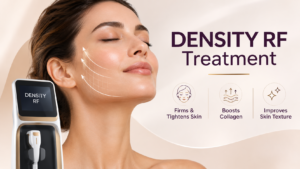
Discover a science-led approach to firmer, smoother and more youthful-looking skin without surgery.
Skin ageing is a gradual process. Over time, collagen production and skin elasticity decline, facial contours become less defined, and fine lines begin to appear. While skincare products can help maintain skin health, they cannot always address the structural changes responsible for visible skin laxity.
DENSITY RF treatment offers a non-surgical approach to improving skin firmness and texture using controlled radiofrequency energy. By delivering thermal energy to targeted tissue layers, this advanced technology is designed to stimulate collagen remodelling and support gradual skin tightening.
Unlike procedures that require surgical incisions or injectable products, DENSITY RF works by encouraging the skin’s natural response to controlled heating. It is an option for individuals who want to address early signs of ageing while preserving their natural facial appearance.
What Is DENSITY RF Treatment?
DENSITY RF is a non-invasive, energy-based skin treatment developed by Jeisys Medical. It uses radiofrequency (RF) energy to heat selected layers of the skin in a controlled manner, encouraging tissue contraction and collagen remodelling.
The technology operates at a radiofrequency of 6.78 MHz and is designed to deliver energy through the skin surface without using needles or surgical incisions.
Depending on the device configuration and treatment tip, DENSITY can use monopolar radiofrequency alone or a combination of monopolar and bipolar radiofrequency energy.
These two energy-delivery methods have different characteristics:
- Monopolar RF: Delivers energy through a broader and deeper volume of tissue, supporting collagen remodelling and improvement in skin firmness.
- Bipolar RF: Concentrates energy more locally, helping target relatively superficial skin layers.
When compatible dual-mode tips are used, the treatment can combine these approaches in a sequential energy-delivery process.
DENSITY RF is primarily considered for people experiencing mild to moderate skin laxity, early facial ageing, reduced firmness and changes in skin texture.
It is important to understand that DENSITY RF is not a surgical facelift. Its purpose is to provide gradual, generally subtle-to-moderate improvements in skin quality and tightness rather than dramatic repositioning of sagging tissues.
How Does DENSITY RF Treatment Work?
The effectiveness of radiofrequency-based skin tightening is based on the response of skin tissue to controlled thermal energy.
The dermis, which lies beneath the outermost layer of the skin, contains collagen and elastin fibres that help maintain firmness, resilience and structural support.
As skin ages, these fibres undergo changes in quantity, quality and organisation. This contributes to wrinkles, loss of elasticity and sagging.
DENSITY RF is designed to address some of these changes through a controlled heating process.
Step 1: Controlled Radiofrequency Energy Delivery
During treatment, the practitioner places a specialised handpiece against the skin. The device delivers radiofrequency energy into the targeted tissue.
As the energy passes through tissue, electrical resistance generates heat. The treatment settings are selected according to the treatment area, skin condition and clinical assessment.
Step 2: Thermal Effects on Existing Collagen
When collagen-containing tissue reaches an appropriate therapeutic temperature, heat can cause structural changes in collagen fibres and controlled tissue contraction.
This mechanism may contribute to an early tightening effect in some patients.
However, immediate changes can be subtle and should not be interpreted as the final treatment result.
Step 3: Collagen Remodelling
Controlled heating also initiates a biological repair response. Over the following weeks and months, fibroblasts—the cells responsible for producing important components of the skin’s extracellular matrix—participate in tissue remodelling.
This process may support new collagen formation and improvements in skin firmness and elasticity.
Step 4: Gradual Improvement in Skin Quality
As tissue remodelling progresses, some patients may notice improved skin tightness, smoother-looking texture and better-defined facial contours.
The degree of improvement depends on factors such as age, baseline skin laxity, treatment settings, individual healing response and the number of sessions performed.
What Makes DENSITY RF Technology Different?
DENSITY incorporates several features designed to improve energy delivery, treatment customisation and patient comfort.
- Monopolar and Bipolar RF Technology
One of the distinguishing features of compatible DENSITY systems is the ability to combine monopolar and bipolar RF energy.
Monopolar RF distributes energy through a relatively larger tissue volume, whereas bipolar RF delivers more localised heating.
By combining these methods, practitioners can target different tissue depths during a treatment session.
The precise energy sequence depends on the device model and treatment tip.
- Sequential Energy Delivery
Compatible DENSITY High tips are designed to deliver monopolar and bipolar RF sequentially within a treatment pulse.
This allows the practitioner to use complementary heating patterns rather than relying exclusively on a single RF mode.
Preclinical research has investigated whether combined monopolar and bipolar RF delivery can produce different collagen-remodelling responses compared with either mode alone.
However, promising laboratory findings should not be interpreted as proof that DENSITY produces superior clinical outcomes for every patient.
- Intelligent Impedance Feedback
Skin and underlying tissues vary in electrical resistance, also known as impedance.
DENSITY incorporates an impedance feedback system designed to monitor tissue resistance and adjust energy delivery.
This helps the device respond to differences in tissue characteristics during treatment.
Although this technology supports more controlled energy delivery, it does not eliminate the possibility of burns or other adverse effects.
- Five-Level Cooling Technology
DENSITY uses an adjustable cooling system designed to protect the skin surface while radiofrequency energy heats the underlying tissue.
The cooling mechanism helps manage epidermal temperature and may improve comfort during treatment.
Different cooling levels allow the practitioner to customise the procedure according to the patient’s needs and the treatment area.
- Different Treatment Tips
DENSITY offers different treatment tips for areas such as the face, smaller facial regions and broader treatment surfaces.
The availability and functionality of these tips depend on the specific device configuration.
For example, certain Classic tips deliver monopolar RF only, while compatible High tips support sequential monopolar and bipolar RF.
A qualified practitioner should select the appropriate tip based on the patient’s anatomy, skin characteristics and treatment goals.
Benefits of DENSITY RF Treatment
DENSITY RF is designed to improve skin firmness and support facial rejuvenation without surgery.
- Non-Surgical Skin Tightening
One of the main reasons patients consider DENSITY RF is the desire to improve mild or moderate skin laxity.
Controlled heating can encourage tissue contraction and collagen remodelling, potentially making the treated skin appear firmer over time.
- Improved Facial Contours
As skin loses elasticity, areas such as the lower cheeks and jawline may appear less defined.
DENSITY RF may improve the appearance of mild laxity in these areas, contributing to a more refined facial outline.
It does not replace surgical lifting when significant tissue descent is present.
- Reduction in the Appearance of Fine Lines
Collagen remodelling may improve the appearance of certain fine lines, particularly those associated with changes in skin firmness.
Deeper wrinkles caused by repetitive muscle movement or substantial volume loss may require other treatments.
- Improved Skin Elasticity
The treatment aims to support the skin’s collagen network, which plays an important role in maintaining elasticity and resilience.
Patients may notice a gradual improvement in how firm and supple their skin feels.
- Smoother-Looking Skin Texture
Some patients may experience improvements in overall skin texture as collagen remodelling occurs.
However, DENSITY RF should not be considered a primary treatment for deep acne scars, severe pigmentation or other conditions requiring targeted therapies.
- No Surgical Incisions
DENSITY RF is performed through contact with the skin surface. It does not require surgical incisions, stitches or tissue removal.
- Minimal Expected Downtime
Many patients can return to their routine activities shortly after treatment.
Temporary redness, warmth, swelling or sensitivity may occur, and recovery varies between individuals.
- Natural-Looking, Gradual Changes
Because the treatment relies on the body’s tissue-remodelling response, improvements generally develop progressively rather than through an immediate dramatic change in facial structure.
For patients seeking subtle rejuvenation, this gradual approach may be appealing.
Which Areas Can Be Treated With DENSITY RF?
The areas suitable for treatment depend on the device configuration, available tips, local regulatory indications and the practitioner’s assessment.
Face and Cheeks
DENSITY RF may be used to address reduced skin firmness, mild cheek laxity and early changes in facial texture.
Jawline and Lower Face
Mild skin laxity around the jawline can make the lower face appear less defined.
RF treatment may help improve the appearance of skin firmness in this region, although it cannot correct substantial jowling or replace a surgical lift.
Periorbital Area
Fine lines and laxity around the eyes are common concerns as skin ages.
Treatment near the eyes requires specialised techniques, compatible treatment tips and strict adherence to device-specific safety instructions.
Not every patient or device configuration is suitable for this area.
Neck
The neck may develop fine lines and skin laxity due to ageing, sun exposure and changes in skin structure.
Radiofrequency treatment may be considered for selected patients with mild neck skin laxity, subject to device indications and clinical assessment.
Other Areas
Some device configurations include larger treatment tips for broader areas.
Suitability for any body area must be established by the treating clinician rather than assuming that a facial treatment protocol can be applied elsewhere.
Who Is an Ideal Candidate for DENSITY RF?
DENSITY RF may be appropriate for adults who want to improve skin firmness without undergoing surgery.
Potential candidates include individuals who:
- Have mild to moderate facial skin laxity.
- Notice early loss of jawline definition.
- Want to improve the appearance of fine lines.
- Are concerned about reduced skin elasticity.
- Prefer a non-invasive approach to facial rejuvenation.
- Have realistic expectations about gradual and modest improvements.
- Want a treatment with limited expected recovery time.
There is no single ideal age for DENSITY RF.
Skin condition, medical history, facial anatomy and treatment expectations are more important than chronological age alone.
Patients with significant skin sagging, substantial facial volume loss or advanced structural ageing may benefit more from alternative or combination approaches.
What Happens During a DENSITY RF Treatment Session?
A DENSITY RF session usually involves several stages.
Step 1: Dermatologist Consultation
The dermatologist assesses skin quality, laxity, facial anatomy and relevant medical history.
The consultation should include a discussion of treatment goals, expected improvement, potential side effects and alternative options.
Step 2: Skin Preparation
The treatment area is cleansed to remove makeup, skincare products and surface impurities.
The practitioner prepares the device and follows the manufacturer’s instructions regarding skin contact, coupling materials, treatment tips and any return electrode required.
Step 3: Treatment Planning
The dermatologist selects appropriate energy settings, treatment areas and the number of pulses according to the patient’s needs.
The treatment plan may differ for the cheeks, jawline and other suitable regions.
Step 4: Radiofrequency Application
The handpiece is positioned against the skin, and controlled radiofrequency pulses are delivered.
Patients may experience a warming sensation, brief heat pulses or mild discomfort.
The cooling system is designed to reduce surface heating and improve comfort.
The practitioner monitors the patient’s response throughout the procedure.
Step 5: Post-Treatment Assessment
After treatment, the skin is assessed for redness, swelling, tenderness or other reactions.
The patient receives instructions on skincare, sun protection and any activities or products that should temporarily be avoided.
Is DENSITY RF Treatment Painful?
Discomfort varies from person to person.
During treatment, patients may experience warmth, brief intense heating sensations or mild stinging in sensitive areas.
DENSITY incorporates adjustable cooling to help protect the skin surface and improve treatment comfort.
Some patients may tolerate the procedure without significant discomfort, while others may require adjustments to the treatment settings.
Patients should immediately inform their practitioner if they experience excessive pain, burning or unusual sensations.
The treatment should not be described as completely painless for everyone.
How Long Does a DENSITY RF Session Take?
The duration of treatment depends on the area being treated, the number of pulses and the treatment protocol.
A facial session may take approximately 30–60 minutes, although some appointments may be shorter or longer.
Additional time may be required for consultation, skin preparation and post-treatment assessment.
The treating clinic should provide a more accurate estimate after evaluating the intended treatment area.
DENSITY RF Results: What Can You Realistically Expect?
Understanding the expected timeline is important before undergoing any radiofrequency skin-tightening procedure.
Immediately After Treatment
Some patients may notice a mild tightening sensation or subtle improvement in skin firmness.
Temporary redness or swelling may also affect the initial appearance.
Immediate changes should not be considered a reliable indication of the final outcome.
After 4–6 Weeks
Early tissue-remodelling changes may become more noticeable.
Some patients begin to observe improvements in skin texture, firmness or facial contour.
After 2–3 Months
Collagen remodelling may continue, and improvements can become more apparent.
The response varies depending on baseline skin condition, age, treatment intensity and individual biology.
After 3–6 Months
Further tissue remodelling may occur over several months.
Results should be evaluated using consistent photographs, clinical examination and patient-reported outcomes rather than relying solely on subjective impressions immediately after treatment.
Important: Not every patient experiences visible improvement, and the degree of change cannot be guaranteed.
How Many DENSITY RF Sessions Are Required?
The number of sessions depends on the patient’s skin condition, treatment goals and clinical response.
Some patients may be offered a single initial treatment followed by reassessment, while others may be advised to undergo additional sessions.
There is no universal treatment schedule appropriate for everyone.
Manufacturer educational material discusses treatment plans involving one or two sessions and maintenance treatments, but the ideal interval should be determined by a qualified practitioner.
More frequent treatment does not necessarily mean better results.
How Long Do DENSITY RF Results Last?
DENSITY RF does not permanently stop skin ageing.
Even when treatment improves collagen structure and skin firmness, natural ageing, sun exposure, hormonal changes and lifestyle factors continue to influence skin quality.
Some patients may maintain visible improvements for several months or longer, but the duration is variable.
Maintenance treatment may be considered after reviewing the clinical response.
A specific duration, such as 12 or 18 months, should not be guaranteed without appropriate supporting evidence.
DENSITY RF vs HIFU: What Is the Difference?
DENSITY RF and high-intensity focused ultrasound (HIFU) are both energy-based technologies used in non-surgical aesthetic medicine, but they work differently.
| Feature | DENSITY RF | HIFU |
| Energy | Radiofrequency | Focused ultrasound |
| Mechanism | Controlled electrical heating | Focused thermal coagulation |
| Main focus | Skin firmness and collagen remodelling | Tissue tightening at selected focal depths |
| Treatment delivery | Surface-contact RF applicator | Ultrasound transducer |
| Needles | No | No |
| Downtime | Usually limited | Usually limited |
| Best suited for | Selected skin-quality and mild-laxity concerns | Selected lifting and laxity concerns |
Neither technology is universally superior.
The choice depends on skin thickness, degree of laxity, facial fat distribution, treatment area, clinical goals and the practitioner’s experience.
DENSITY RF vs RF Microneedling
Although both technologies use radiofrequency energy, they are not the same treatment.
DENSITY RF delivers energy through a surface-contact applicator without penetrating the skin with needles.
RF microneedling uses fine needles to deliver radiofrequency energy at selected depths within the skin.
RF microneedling is commonly considered for concerns such as acne scars, skin texture and selected rejuvenation indications, depending on the device.
DENSITY RF is primarily positioned as a non-invasive skin-tightening and collagen-remodelling treatment.
The appropriate option depends on the specific skin concern.
DENSITY RF vs Thermage
Thermage and DENSITY are radiofrequency-based skin treatments designed to produce controlled tissue heating.
Traditional Thermage technology uses monopolar RF, whereas compatible DENSITY High configurations combine sequential monopolar and bipolar RF delivery.
Both approaches aim to improve skin firmness through thermal effects and subsequent tissue remodelling.
However, differences in technology do not automatically establish that one device produces better results.
Direct comparative clinical evidence, treatment parameters, patient characteristics and practitioner expertise must be considered before making superiority claims.
Is DENSITY RF Treatment Safe?
DENSITY RF incorporates technologies such as adjustable cooling and impedance feedback to support controlled energy delivery.
Nevertheless, radiofrequency treatment involves thermal energy, and inappropriate application can cause tissue injury.
Potential adverse effects include:
- Temporary redness or swelling.
- Warmth, tenderness or skin sensitivity.
- Temporary discomfort.
- Burns or blistering.
- Changes in skin pigmentation.
- Unwanted changes in subcutaneous tissue or facial contour.
- Rare prolonged pain, altered sensation or scarring.
The risk of complications depends on treatment settings, anatomical location, device operation, skin characteristics and clinical expertise.
Safety systems reduce certain risks but cannot guarantee a complication-free procedure.
Treatment should be performed by an appropriately trained medical professional following the manufacturer’s instructions and applicable regulations.
Who Should Avoid DENSITY RF Treatment?
Not everyone is suitable for energy-based skin treatments.
Patients should disclose their complete medical history before treatment.
Particular caution or avoidance may be necessary in individuals with:
- Pacemakers or other implanted electronic devices.
- Certain metallic implants in or near the treatment area.
- Active skin infections or open wounds.
- Significant inflammatory skin conditions in the intended treatment area.
- Pregnancy, where treatment safety has not been adequately established.
- A history of abnormal scarring or impaired wound healing.
- Certain neurological conditions or reduced sensation in the treatment area.
- Recent aesthetic procedures that may affect treatment safety.
The presence of a dental implant, previous filler treatment or another medical device does not automatically establish eligibility or ineligibility.
These situations require individual assessment against the specific DENSITY device instructions.
DENSITY RF Treatment Aftercare
Although DENSITY RF generally involves limited recovery time, appropriate aftercare helps protect the treated skin.
First 24 Hours
- Cleanse the skin gently.
- Use a suitable moisturiser as advised.
- Avoid rubbing or aggressively massaging the treated area.
- Avoid excessive heat exposure if the skin remains sensitive.
- Follow the dermatologist’s instructions regarding exercise, makeup and skincare products.
Next 48–72 Hours
- Use broad-spectrum sunscreen with SPF 30 or higher.
- Avoid harsh exfoliants or irritating skincare products until the skin has settled.
- Avoid unnecessary heat exposure if redness or tenderness persists.
- Do not pick or scratch any irritated areas.
Long-Term Skin Maintenance
Consistent sun protection, an appropriate skincare routine and healthy lifestyle habits support general skin health.
Patients should contact their treating clinic promptly if they experience blistering, persistent severe pain, increasing swelling, unusual skin discolouration or other concerning symptoms.
DENSITY RF Treatment Cost in India
The cost of DENSITY RF treatment in India varies according to the clinic, location, device configuration and treatment protocol.
Factors affecting pricing include:
- The area being treated.
- The number and type of treatment pulses.
- The specific DENSITY tip used.
- Whether the treatment involves the full face or a smaller region.
- The dermatologist’s expertise.
- The number of sessions recommended.
- Clinic-specific pricing and follow-up arrangements.
Patients should request a personalised quotation after consultation.
It is also important to confirm that the clinic uses authentic, compatible treatment tips and follows appropriate hygiene and safety procedures.
Choosing a treatment solely on the basis of the lowest price may overlook important differences in medical supervision and treatment quality.
Why Dermatologist Expertise Matters
Energy-based treatments require more than access to advanced equipment.
A qualified dermatologist evaluates the skin’s anatomy, determines whether the treatment is appropriate and selects the safest suitable protocol.
Proper assessment is particularly important when treating delicate areas or patients with a history of fillers, facial procedures, pigmentation disorders or other medical concerns.
An experienced practitioner should also explain the limitations of DENSITY RF and recommend alternative treatments when RF tightening is unlikely to achieve the desired outcome.
The objective should be an individualised treatment plan rather than treating every patient with the same settings or number of pulses.
Frequently Asked Questions About DENSITY RF Treatment
- Is DENSITY RF good for skin tightening?
DENSITY RF is designed to support skin tightening through controlled radiofrequency heating and collagen remodelling. It may help selected patients with mild to moderate skin laxity, although results vary.
- Does DENSITY RF stimulate collagen production?
Radiofrequency-induced heating can stimulate biological processes associated with collagen remodelling and new collagen formation. The extent of the response varies between individuals.
- Is DENSITY RF better than HIFU?
Neither is universally better. DENSITY RF and HIFU use different forms of energy and have different treatment characteristics. The appropriate option depends on the patient’s anatomy and goals.
- Is DENSITY RF a laser treatment?
No. DENSITY RF uses radiofrequency energy rather than laser light. Its tissue-heating mechanism differs from that of laser-based skin treatments.
- Does DENSITY RF use needles?
No. Conventional DENSITY RF treatment uses a surface-contact applicator. It should not be confused with RF microneedling, which uses needles to deliver energy into the skin.
- Can DENSITY RF reduce wrinkles?
It may improve the appearance of certain fine lines associated with skin laxity. Deep expression lines and wrinkles caused by volume loss may respond better to other treatments.
- Can DENSITY RF improve a double chin?
DENSITY RF may improve the appearance of mild skin laxity beneath the chin in suitable patients. It should not be assumed to remove significant submental fat or correct all causes of a double chin.
- Is DENSITY RF suitable for all skin types?
Radiofrequency is not primarily dependent on pigment absorption in the way that some laser treatments are. However, suitability still depends on skin condition, medical history, treatment parameters and clinical assessment.
- Can DENSITY RF cause facial fat loss?
Unwanted changes in subcutaneous tissue or facial contour are possible with thermal energy-based procedures. Patients with naturally thin faces or concerns about facial volume should discuss this risk carefully with their dermatologist.
- Can DENSITY RF be performed around the eyes?
Certain configurations include tips designed for smaller areas, but treatment around the eyes requires appropriate device indications, specialised precautions and an experienced practitioner.
- How soon can I wash my face after DENSITY RF?
Many patients can resume gentle cleansing relatively soon after treatment, depending on the skin’s condition and the dermatologist’s instructions. Harsh scrubbing should be avoided while the skin is sensitive.
- Is there downtime after DENSITY RF?
Downtime is generally limited. Some patients experience temporary redness, swelling, warmth or tenderness. Recovery time varies.
- At what age should someone start DENSITY RF?
There is no fixed age. Treatment decisions should be based on skin laxity, individual concerns, medical suitability and realistic expectations rather than age alone.
- Can DENSITY RF replace a facelift?
No. DENSITY RF may improve mild to moderate skin laxity, but it cannot reproduce the degree of tissue repositioning achieved through surgical facelift procedures.
- Are DENSITY RF results permanent?
No. The skin continues to age naturally. Improvements may persist for a period of time, but the duration varies, and maintenance treatments may be considered.
- Can DENSITY RF be combined with Botox or fillers?
Combination treatment may be possible, but timing and sequencing require professional assessment. Existing fillers, treatment location and the characteristics of other procedures must be considered.
- How do I know whether a clinic uses an authentic DENSITY device?
Ask the clinic about the device manufacturer, exact model, compatible treatment tips, regulatory documentation and practitioner training. Authentic single-use tips should be handled according to manufacturer instructions.
- How many DENSITY RF shots are needed for the face?
There is no universal shot count. The appropriate number depends on the treatment area, device configuration, selected tip, energy settings and individual treatment plan.
Final Thoughts: Is DENSITY RF Worth Considering?
DENSITY RF represents an advancement in non-invasive radiofrequency technology, combining controlled tissue heating with features designed to support treatment customisation and patient comfort.
For suitable patients experiencing early signs of skin ageing, reduced firmness or mild facial laxity, it may offer a way to improve skin quality without surgery.
However, successful treatment depends on realistic expectations, appropriate patient selection, careful energy delivery and qualified medical supervision.
The most important first step is a personalised dermatological assessment to determine whether DENSITY RF—or another treatment—is the most suitable approach for your skin.
Interested in DENSITY RF skin tightening?
Book a consultation with a qualified dermatologist to understand your skin concerns, treatment suitability, expected results and personalised treatment options.
Medical disclaimer: This information is intended for patient education and does not replace individual medical advice. Treatment suitability, safety, expected outcomes and approved uses depend on the specific device and clinical circumstances.