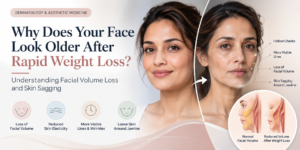
Losing weight can be a significant achievement, often improving overall health, mobility and confidence. However, some people notice an unexpected change after substantial weight loss: their face appears thinner, less youthful or more tired than before.
Cheeks may look hollow, the skin around the jawline may appear loose, and fine lines can become more noticeable. These changes are sometimes informally described as weight-loss face or Ozempic face, although they are not medical diagnoses.
Why does this happen? The answer lies in the relationship between facial fat, skin elasticity, collagen, ageing and the speed and extent of weight loss.
Understanding these changes can help you distinguish between normal facial volume reduction and concerns that may benefit from dermatological assessment.
- Why Does Rapid Weight Loss Change Your Facial Appearance?
The face contains several compartments of fat that contribute to its shape, contours and overall appearance. These fat compartments provide fullness to the cheeks, support surrounding tissues and help create smooth transitions between facial features.
When a person loses a substantial amount of body weight, facial fat may also decrease.
This can lead to:
- Reduced cheek fullness and more prominent cheekbones
- Hollowing around the temples and beneath the eyes
- More visible nasolabial folds
- Increased appearance of fine lines and wrinkles
- Loose skin around the lower face and jawline
- A more tired or aged facial appearance
Not everyone experiences these changes to the same degree. Genetics, age, baseline facial structure, skin quality and the total amount of weight lost all influence the outcome.
Importantly, these changes are not necessarily caused by losing weight too quickly alone. The total amount of weight lost, age-related changes and individual skin elasticity may be equally or more important.
- What Happens to Facial Fat During Weight Loss?
Facial fat plays an important role in maintaining youthful contours.
As body fat decreases, some of the fat compartments in the face can also become smaller. This reduction may make underlying anatomical structures more visible.
For example, loss of cheek volume can make the area beneath the eyes appear hollow. Reduced fullness in the midface may also make existing facial folds more noticeable.
Facial ageing itself involves several processes, including changes in fat distribution, skin quality, bone structure and soft-tissue support. Significant weight loss can make some of these age-related features more apparent.
However, facial fat loss does not always mean that the skin has aged more rapidly. In many cases, the appearance of ageing reflects changes in facial volume and tissue support rather than accelerated biological skin ageing.
- Why Does Skin Sag After Weight Loss?
Skin is a complex tissue containing collagen, elastin and other structural components.
Collagen contributes to skin strength, while elastin helps the skin stretch and return towards its original shape.
When body weight increases, the skin gradually accommodates changes in underlying tissue volume. After substantial weight loss, the skin may not completely contract to match the reduced volume.
Several factors influence this process.
Age
With increasing age, collagen production and skin elasticity gradually decline. Older skin may therefore have less ability to adapt to major volume changes.
Genetics
Inherited differences in skin structure, connective tissue and facial anatomy can affect how skin responds to weight loss.
Sun exposure
Long-term ultraviolet exposure damages collagen and elastin, contributing to wrinkles and reduced skin elasticity.
Smoking
Smoking is associated with premature skin ageing and impaired collagen maintenance.
Amount and duration of weight change
Larger changes in weight, particularly after prolonged skin stretching, may leave more noticeable loose skin.
These factors help explain why two people who lose a similar amount of weight may experience very different changes in facial appearance.
- What Is Ozempic Face?
The expression Ozempic face has become popular in discussions about weight-loss medications, particularly GLP-1 receptor agonists such as semaglutide.
It describes facial hollowing, increased wrinkle visibility and loose skin that some individuals notice after significant weight reduction.
However, it is important to understand that Ozempic face is not an officially recognised medical condition or a side effect unique to semaglutide.
Similar facial changes can occur following substantial weight loss through dietary changes, exercise, bariatric surgery or other medical weight-management treatments.
There is insufficient evidence to conclude that semaglutide directly causes facial skin ageing independently of weight loss.
People taking prescribed weight-management medications should not discontinue or modify treatment because of cosmetic concerns without discussing them with their prescribing clinician.
- Can Facial Volume Loss Be Reversed Naturally?
The possibility of improvement depends on the underlying cause.
Some changes in facial appearance may become less noticeable as body weight stabilises, hydration improves and the skin adapts over time.
However, lost facial fat does not necessarily return unless weight is regained, and regaining weight solely to restore facial fullness may not be medically appropriate.
A few measures can support overall skin health.
Adequate nutrition: A balanced diet containing sufficient protein, vitamins and minerals supports normal tissue maintenance. Nutritional deficiencies can adversely affect skin and hair health.
Sun protection: Daily broad-spectrum sunscreen with SPF 30 or higher can help reduce additional UV-related collagen damage.
Avoiding smoking: Smoking cessation supports skin health and reduces exposure to factors associated with premature ageing.
Appropriate skincare: Moisturisers can improve skin hydration and temporarily reduce the appearance of fine lines. Certain topical retinoids may improve photoaged skin over time, but they do not restore lost facial fat.
Maintaining a stable, healthy weight: Avoiding repeated cycles of substantial weight gain and loss may help limit further changes in facial appearance.
No cream, supplement, facial exercise or massage has been conclusively demonstrated to restore substantial amounts of lost facial fat.
- What Dermatological Treatments May Help After Weight Loss?
Treatment depends on whether the primary concern is facial volume loss, skin laxity, wrinkles or a combination of these changes.
A dermatologist may assess facial anatomy, skin quality, medical history and treatment expectations before discussing suitable options.
- Hyaluronic Acid Dermal Fillers
Hyaluronic acid fillers may be considered for selected patients with facial volume loss, particularly around the cheeks or other appropriate areas.
They can provide temporary volume and contour changes, depending on the product and injection technique.
However, fillers are medical procedures and carry risks, including swelling, bruising, infection, nodules and vascular occlusion. Rare vascular complications can cause tissue injury, visual impairment or blindness.
Treatment should only be performed by an appropriately qualified and trained medical professional using suitable products and techniques.
- Radiofrequency-Based Skin Tightening
Radiofrequency technologies deliver controlled energy to tissues with the aim of producing thermal effects that may stimulate collagen remodelling.
Some devices are used to address mild-to-moderate skin laxity.
Results vary according to the device, treatment parameters, individual anatomy and degree of laxity. Multiple sessions may be recommended in selected cases.
Radiofrequency treatment does not replace significant lost facial fat and is unlikely to correct substantial excess skin.
Potential adverse effects include burns, pigmentation changes, scarring and unwanted fat loss, depending on the technology and technique.
- Radiofrequency Microneedling
Radiofrequency microneedling combines microneedles with radiofrequency energy delivered at controlled depths.
It may be considered for selected concerns involving skin texture, wrinkles and mild laxity.
However, evidence varies across devices and indications, and outcomes are not guaranteed.
Potential complications include burns, infection, pigmentation changes, scarring, nerve injury and unwanted fat loss. The US FDA has issued safety communications concerning serious complications associated with certain uses of RF microneedling.
Patients with already reduced facial fat require particularly careful assessment because further volume loss could worsen facial hollowing.
- Ultrasound-Based Skin Tightening
Certain focused ultrasound technologies are used for non-surgical skin tightening.
They deliver energy at selected tissue depths and may produce modest improvements in laxity in appropriately selected patients.
The degree of improvement varies, and the treatment is not a substitute for surgical lifting when excess skin is substantial.
Possible adverse effects include pain, swelling, burns, nerve-related symptoms and unintended tissue injury.
- Collagen-Stimulating Injectables
Some injectable treatments are designed to stimulate tissue responses associated with collagen formation.
Depending on the product, indication and regulatory approval, they may be considered for selected facial contour or skin-quality concerns.
However, the evidence, safety profile and suitability differ substantially between products.
Potential complications include nodules, inflammation, infection and vascular injury.
- Surgical Options
When significant excess skin is present, non-surgical procedures may provide insufficient improvement.
A qualified plastic surgeon may discuss surgical options, including facial lifting procedures, where clinically appropriate.
Surgery carries its own risks, recovery requirements and limitations, and should not be presented as necessary for everyone experiencing facial changes after weight loss.
- Can Skin Tightening Treatments Replace Lost Facial Volume?
Not necessarily.
Facial volume loss and skin laxity are related but distinct concerns.
| Facial concern | Potential management approach |
| Hollow cheeks | Assessment for volume-restoration options |
| Mild skin laxity | Selected energy-based treatments may help |
| Fine lines and texture changes | Skincare and appropriate dermatological procedures |
| Significant loose facial skin | Surgical consultation may be appropriate |
| Combination of volume loss and laxity | Individualised assessment of both concerns |
For example, tightening the skin without addressing underlying volume loss may not produce the desired facial contour. Conversely, adding volume when significant excess skin is present may not adequately correct sagging.
An individualised approach is therefore more appropriate than selecting a treatment based only on its popularity.
- Does Rapid Weight Loss Cause Premature Ageing?
Significant weight loss may make some facial ageing features more noticeable, but this does not necessarily mean that the skin has biologically aged faster.
The visible changes may reflect reduced facial fat, pre-existing collagen loss, skin laxity and changes in facial contours.
Rapid or excessive weight loss can also be associated with inadequate nutritional intake in some individuals. Nutritional deficiencies may contribute to skin and hair problems.
However, a direct relationship between the speed of weight loss and permanent facial ageing has not been established for every individual.
Gradual, medically appropriate weight management and adequate nutrition remain important for overall health.
- When Should You Consult a Dermatologist?
A dermatological consultation may be useful when facial changes after weight loss are persistent, bothersome or difficult to understand.
Assessment may be particularly helpful if you notice pronounced facial hollowing, loose skin, changes in texture or worsening pigmentation.
A dermatologist can evaluate whether the main concern involves skin quality, tissue volume, laxity or another condition.
If weight loss has been unintentional or unexplained, it is important to consult a physician to investigate the underlying cause rather than treating the facial appearance alone.
The purpose of consultation should be to understand available options, realistic outcomes and potential risks—not to assume that cosmetic treatment is necessary.
- Frequently Asked Questions
- Why does my face look older after losing weight?
Significant weight loss can reduce facial fat, making the cheeks appear hollow and existing folds or wrinkles more noticeable. Reduced skin elasticity may also contribute to sagging.
- Will my face regain its fullness after weight loss?
Some changes in appearance may improve as weight stabilises, but substantial lost facial fat does not necessarily return. Outcomes vary.
- Can collagen supplements tighten loose facial skin?
Some studies suggest modest improvements in certain skin measurements with oral collagen supplements, but the evidence has limitations. They have not been shown to reliably restore lost facial fat or correct substantial skin laxity.
- Does Ozempic permanently damage facial skin?
There is insufficient evidence that semaglutide directly damages facial skin independently of weight loss. The facial changes commonly described as Ozempic face are largely associated with loss of facial volume.
- What is the best treatment for facial sagging after weight loss?
There is no single best treatment. The appropriate approach depends on the degree of volume loss, skin laxity, age, medical history and patient preferences.
- Are non-surgical skin tightening treatments safe?
Some are appropriate for selected patients, but all procedures have potential risks. Safety depends on the technology, operator expertise, treatment settings and individual patient factors.
- Can exercise restore facial fat?
Exercise supports general health but cannot selectively restore facial fat or reliably tighten substantial excess facial skin.
- Is facial volume loss always a cosmetic concern?
No. Facial changes may occur with normal ageing or intentional weight loss, but unexplained or rapid unintentional weight loss warrants medical evaluation.
Conclusion
Facial changes after rapid or substantial weight loss are common enough to be recognised in clinical and public discussions, but they vary considerably between individuals.
Reduced facial fat, changes in tissue support and decreased skin elasticity can make the face appear hollow, tired or older. These changes do not necessarily indicate accelerated skin ageing.
Maintaining adequate nutrition, protecting the skin from sun damage and allowing time for weight stabilisation are sensible first steps.
For people considering cosmetic treatment, the most important step is identifying whether the concern is volume loss, skin laxity or both. A qualified dermatologist can explain the available approaches, their limitations and their risks.