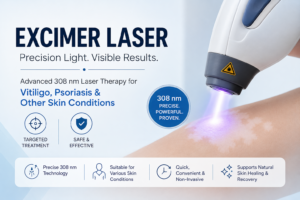
Skin conditions do not always affect large areas of the body. Sometimes, a person may have a few stubborn patches of vitiligo, localized psoriasis, or another inflammatory skin condition that has not responded adequately to conventional treatment. In such situations, treating the entire body may not always be necessary or practical.
This is where Excimer Laser treatment can have an important role in dermatology.
Excimer laser is a targeted form of phototherapy that delivers 308 nm ultraviolet B (UVB) light directly to affected areas of the skin. Unlike conventional phototherapy, where larger areas of the body may be exposed to therapeutic light, Excimer Laser treatment allows the dermatologist to concentrate the treatment on selected patches while minimizing unnecessary exposure of surrounding healthy skin.
The treatment has been particularly studied and used for vitiligo and psoriasis, although dermatologists may consider it for several other localized inflammatory or pigmentary skin disorders depending on the individual patient’s condition. Scientific reviews have reported its use in conditions including atopic dermatitis, alopecia areata, localized scleroderma, lichen sclerosus, granuloma annulare and several other disorders.
For patients considering Excimer Laser treatment in Delhi, one of the most important things to understand is that this is not simply a cosmetic laser procedure. It is a medical phototherapy treatment that should be selected and administered after proper dermatological evaluation.
What Is Excimer Laser Treatment?
Excimer Laser treatment is a form of targeted phototherapy that generally uses a 308 nm wavelength of ultraviolet B light.
The term “excimer” comes from the technology used to generate the therapeutic light. In dermatology, the 308 nm xenon-chloride excimer system has become an established form of targeted phototherapy.
The basic idea is simple: instead of exposing a large area of normal and affected skin to UVB, the dermatologist directs the therapeutic light specifically towards the skin that requires treatment.
This targeted approach can be particularly useful when the affected area is relatively limited.
For example, consider a person with a few small patches of vitiligo on the face, hands or body. Treating only those areas can be more convenient than exposing large areas of unaffected skin to phototherapy.
Similarly, in localized psoriasis, Excimer Laser therapy may be considered when certain plaques are resistant to topical treatment or when a focused approach is appropriate.
Research has found that 308 nm excimer treatment can produce therapeutic responses in several UV-responsive skin disorders, with established applications particularly in vitiligo and psoriasis.
How Does the Excimer Laser Work?
The mechanism behind Excimer Laser therapy is different from that of many cosmetic lasers.
It does not primarily work by resurfacing the skin or removing pigmentation. Instead, the 308 nm UVB light produces biological effects within the skin that can help regulate abnormal immune and inflammatory activity.
This is particularly relevant in diseases such as vitiligo and psoriasis, where immune-system activity plays an important role.
In vitiligo, the immune system attacks melanocytes, the cells responsible for producing melanin. The resulting loss of melanocytes leads to characteristic white patches.
Targeted phototherapy may help create an environment that supports repigmentation. In appropriate patients, treatment can stimulate melanocyte activity and migration from areas such as hair follicles and the edges of the affected patches.
In psoriasis, the therapeutic light can help suppress excessive inflammatory activity and reduce the abnormal proliferation of skin cells.
The exact biological mechanisms are complex and vary according to the condition being treated. This is one reason why Excimer Laser should not be thought of simply as a “laser for skin whitening” or a cosmetic laser.
It is a medical treatment for selected dermatological conditions.
One of the most recognised applications of 308 nm Excimer Laser therapy is vitiligo treatment.
Vitiligo is a condition in which areas of skin lose their normal pigmentation because melanocytes are damaged or destroyed. The condition can affect people of any age and may appear on the face, hands, arms, legs, trunk or other areas.
While vitiligo is not contagious and is not usually physically painful, visible patches can have a significant effect on confidence and quality of life.
Treatment depends on several factors, including:
- The type of vitiligo
- Location of the patches
- Extent of pigmentation loss
- Duration of the disease
- Whether the disease is stable or actively progressing
- Previous treatments
- Age of the patient
- Skin type
- Presence of hair within the affected area
For patients with limited or localized vitiligo, Excimer Laser for vitiligo can be an attractive treatment option because the light can be directed specifically towards the depigmented patches.
A dermatologist may combine phototherapy with topical treatments when appropriate.
The goal is not simply to “remove” the white patches. The objective is to encourage repigmentation, which means restoring pigment to the affected skin.
Does Excimer Laser Cure Vitiligo?
It is important to have realistic expectations.
There is currently no single treatment that guarantees a permanent cure for vitiligo in every patient.
Excimer Laser can help selected patients achieve repigmentation, but the response varies significantly from person to person.
Factors such as the location of vitiligo, disease activity, duration and individual response can influence outcomes.
Areas such as the face and neck often respond more favourably to repigmentation therapies than certain areas such as the hands and feet. However, every patient needs individual assessment rather than relying on general expectations.
A dermatologist may also recommend other treatments alongside phototherapy depending on the disease pattern.
Excimer Laser for Psoriasis
Psoriasis is another important condition for which 308 nm Excimer Laser therapy may be considered.
Psoriasis is a chronic inflammatory skin condition that can produce red, scaly, thickened plaques. It commonly affects areas such as the elbows, knees, scalp and trunk, although virtually any skin area can be involved.
Conventional treatment may include topical medicines, phototherapy, oral medications or biologic therapies depending on the severity and type of psoriasis.
For patients with localized psoriasis, targeted Excimer Laser therapy may offer an additional treatment option.
Because the light can be concentrated on the affected plaques, healthy surrounding skin can be spared.
This is particularly useful in situations where only a limited number of stubborn lesions are present.
Scientific literature has supported the use of 308 nm excimer therapy for psoriasis, and the treatment has been generally well tolerated when appropriately administered.
Which Skin Conditions Can Be Treated with Excimer Laser?
Although vitiligo and psoriasis are among the best-known applications, Excimer Laser therapy has been investigated for several other dermatological conditions.
Depending on the specific case and available evidence, dermatologists may consider targeted 308 nm phototherapy for conditions such as:
- Vitiligo
- Psoriasis
- Atopic dermatitis
- Alopecia areata
- Localized scleroderma
- Granuloma annulare
- Lichen sclerosus
- Prurigo nodularis
- Pityriasis alba
- Certain localized inflammatory skin disorders
- Selected hypopigmented disorders
The evidence is stronger for some conditions than others.
A 2024 review of excimer light in dermatology described its role in psoriasis and vitiligo and discussed emerging or additional applications in several other UV-responsive skin diseases.
Therefore, a treatment should never be selected simply because a machine is available. The diagnosis comes first.
Excimer Laser vs Conventional Phototherapy
Patients often ask how Excimer Laser treatment differs from conventional narrowband UVB phototherapy.
Both approaches use UVB light for therapeutic purposes, but the way the treatment is delivered is different.
Narrowband UVB phototherapy is commonly used when larger areas of the skin need treatment. Depending on the setup, the patient may receive treatment in a whole-body or larger-area phototherapy unit.
Excimer Laser therapy, on the other hand, is more focused.
The beam can be directed towards specific lesions or patches.
This means that a patient with a few localized areas may not need to expose large areas of unaffected skin.
One of the recognised advantages of 308 nm excimer treatment is its ability to deliver targeted therapy, potentially allowing higher therapeutic doses to be concentrated on affected areas while sparing nearby normal skin.
However, this does not mean Excimer Laser is automatically better than conventional phototherapy.
The most appropriate option depends on the extent and location of the disease.
Excimer Laser vs Narrowband UVB: Which Is Better?
There is no universal answer.
If someone has widespread vitiligo, for example, whole-body or large-area narrowband UVB may be more practical.
If someone has a few localized patches, targeted Excimer Laser therapy may be more convenient.
The dermatologist may also consider the patient’s age, treatment history, disease activity and response to previous therapies.
The best treatment is therefore the one that fits the patient’s diagnosis and pattern of disease—not necessarily the newest or most expensive technology.
What Happens During Excimer Laser Treatment?
The procedure itself is generally straightforward.
Before treatment begins, the dermatologist evaluates the skin and determines the appropriate treatment parameters.
The treatment dose is individualized. It may depend on factors such as the patient’s skin type, the condition being treated, the location of the lesion and the patient’s response to previous sessions.
During the session, the Excimer device is positioned so that the 308 nm light is directed towards the affected area.
The actual exposure may be very brief, depending on the treatment area and prescribed dose.
Patients generally do not need anesthesia.
After the session, the patient can usually return to normal activities unless the dermatologist provides specific instructions.
Because this is UV-based treatment, however, it should not be confused with ordinary sunlight exposure. Medical phototherapy is carefully dosed and supervised.
How Many Excimer Laser Sessions Are Needed?
This is one of the most common questions patients ask.
There is no fixed number of sessions that works for everyone.
The number and frequency of Excimer Laser sessions depend on:
- The condition being treated
- Size and location of the affected area
- Severity of the disease
- Skin type
- Response to treatment
- Whether other treatments are being used
- Whether the disease is stable or active
Some patients may begin to notice improvement after a number of sessions, while others require a longer treatment course.
Vitiligo, in particular, generally requires patience. Repigmentation is a biological process and does not happen overnight.
It is better to assess progress over a planned treatment course than to expect dramatic changes after one or two sessions.
Is Excimer Laser Treatment Painful?
Most patients tolerate the procedure well.
Depending on the dose and sensitivity of the treated area, some people may experience warmth, mild redness or a sensation similar to a mild sunburn.
The dermatologist adjusts the treatment dose according to the patient’s response.
A significant amount of discomfort is not something that should simply be ignored. If the treated area develops excessive redness, blistering or significant pain, the treating dermatologist should be informed.
What Are the Side Effects of Excimer Laser?
Excimer Laser treatment is generally well tolerated when properly administered, but no medical treatment is completely free of side effects.
Possible reactions include:
- Temporary redness
- Mild burning or warmth
- Itching
- Dryness
- Darkening or tanning of treated skin
- Mild irritation
- Excessive redness if the dose is too high
- Blistering or burns in uncommon situations
The risk of side effects is one reason why treatment should be performed under the supervision of a qualified dermatologist.
The 308 nm excimer literature generally describes relatively few adverse reactions, although appropriate patient selection, dosing and longer-term monitoring remain important.
Is Excimer Laser Safe?
When appropriately prescribed and administered by a dermatologist, Excimer Laser is considered a useful and generally well-tolerated phototherapy modality.
However, “laser” does not automatically mean risk-free.
Excimer therapy uses ultraviolet radiation. Therefore, the dose matters.
The treatment should be individualized rather than using a fixed setting for every patient.
The dermatologist also needs to consider medical history, previous phototherapy, medications, skin sensitivity and the area being treated.
The available scientific literature supports its clinical role but also notes the need for continued research into long-term safety and outcomes.
Who Is a Good Candidate for Excimer Laser?
A patient may be considered for Excimer Laser treatment when there is a suitable localized skin condition that is likely to respond to targeted phototherapy.
Potential candidates may include patients with:
- Localized vitiligo
- Stable or appropriately selected active vitiligo
- Localized psoriasis
- Selected treatment-resistant patches
- Certain localized inflammatory skin diseases
- Selected hypopigmented disorders
But the decision should always be based on diagnosis.
For example, not every white patch is vitiligo.
White or lighter patches can occur because of several different conditions, including fungal infections, post-inflammatory changes, eczema-related pigment loss and other dermatological disorders.
This is why self-diagnosis can be misleading.
A dermatologist should examine the skin before treatment.
Why Diagnosis Matters Before Laser Treatment
A common mistake is to choose a laser treatment before establishing exactly what is causing the skin problem.
This can happen especially when people search online for terms such as:
“best laser for white patches”
“laser treatment for pigmentation”
“laser for skin disease”
or
“best Excimer Laser treatment in Delhi.”
The technology is only one part of the treatment.
The diagnosis is much more important.
For example, a white patch caused by a fungal infection requires a completely different approach from vitiligo.
Similarly, pigmentation caused by acne, melasma, medication or inflammation may require entirely different treatment strategies.
A good dermatologist will first identify the condition and then determine whether Excimer Laser is appropriate.
Excimer Laser Treatment for Indian Skin
Skin of colour requires thoughtful treatment planning.
Patients in India often have a higher tendency towards pigmentation after inflammation or irritation. This is one reason why dermatological laser and light treatments should be customized rather than performed using generic settings.
The dermatologist needs to consider the patient’s natural skin tone, history of pigmentation, treatment area and previous response.
This is particularly important when treating areas such as the face.
The aim should always be controlled medical treatment—not simply using the highest possible energy.
Can Excimer Laser Be Used on the Face?
Yes, targeted Excimer Laser treatment may be used on selected facial skin conditions.
In fact, localized facial lesions can sometimes be suitable for targeted phototherapy.
However, facial skin can be sensitive, and treatment parameters need to be selected carefully.
For vitiligo affecting the face, for example, the dermatologist may consider targeted phototherapy depending on the diagnosis, extent and activity of the disease.
The patient’s overall treatment plan may also include topical medicines or other therapies.
Can Excimer Laser Treat Acne?
Excimer Laser should not be considered a routine first-line treatment for ordinary acne.
Acne is a different disease with its own treatment pathways.
Depending on the type and severity of acne, treatment may include topical retinoids, benzoyl peroxide, antibiotics, hormonal treatment, oral isotretinoin or selected procedures.
Some forms of light and laser therapy have been investigated for acne, but 308 nm Excimer Laser is primarily associated with targeted phototherapy for conditions such as vitiligo and psoriasis, rather than being a standard acne treatment.
This distinction is important because “laser treatment” is a broad term that includes many different technologies.
A dermatologist should select the technology according to the disease.
Can Excimer Laser Treat Pigmentation?
This depends entirely on what is causing the pigmentation.
Excimer Laser is not a general-purpose pigmentation-removal laser.
It is primarily a targeted UVB phototherapy technology.
In some pigmentary disorders involving hypopigmentation or depigmentation, it may have a therapeutic role.
For conditions such as melasma or post-inflammatory hyperpigmentation, however, other treatment approaches are generally more relevant.
Therefore, someone searching for “Excimer Laser for pigmentation” should first determine whether the concern is loss of pigment or excess pigment.
These are fundamentally different problems.
Excimer Laser for White Patches on Skin
White patches on the skin can have several causes.
Vitiligo is one important possibility, but it is not the only one.
If a person notices new white patches, spreading patches or sharply defined areas of depigmentation, a dermatological evaluation is advisable.
Once vitiligo is diagnosed, treatment options can include topical medications, phototherapy and, in selected cases, surgical approaches.
For localized vitiligo, 308 nm Excimer Laser treatment may be considered as part of the treatment plan.
The advantage is that the treatment can be focused on the areas that have lost pigment.
Does Excimer Laser Permanently Remove Vitiligo?
No treatment should be marketed as a guaranteed permanent cure for vitiligo.
Vitiligo can behave differently in different people. Even when repigmentation occurs, maintaining the result depends on several factors, including disease activity and the individual’s response.
The objective of treatment is to achieve the best possible control and repigmentation based on the patient’s specific condition.
This is why follow-up is important.
If new patches appear or existing patches change, the treatment strategy may need to be reassessed.
What Results Can You Expect?
The response to Excimer Laser treatment is individual.
Some patients may experience visible repigmentation, while others may have a more modest response.
The location of the disease matters.
For vitiligo, areas with a greater concentration of hair follicles, such as the face, may respond differently from areas such as the fingertips or feet.
The duration of the condition and whether the disease is stable can also influence the outcome.
Therefore, photographs, clinical examination and follow-up assessments are more meaningful than promises of a specific percentage of improvement.
A responsible dermatologist will explain what is realistically achievable before starting treatment.
How Long Does an Excimer Laser Session Take?
The actual treatment time can be short, especially when only a small area is being treated.
However, the overall appointment can take longer because the dermatologist needs to examine the skin, review the treatment response and determine whether the treatment dose needs adjustment.
The important point is that the procedure itself is usually quick, but successful treatment is not about rushing through sessions.
Consistency and correct dosing are more important.
Excimer Laser Treatment Cost in Delhi
The Excimer Laser treatment cost in Delhi can vary considerably.
There is no single standard price because the overall cost depends on factors such as:
- Size of the treatment area
- Number of patches
- Number of sessions required
- Condition being treated
- Location of the clinic
- Technology and equipment used
- Dermatologist’s expertise
- Whether other treatments are required
Patients should be cautious about choosing a treatment purely on the basis of the lowest advertised price.
The quality of diagnosis, appropriate treatment selection and correct dosing are much more important than simply finding the cheapest session.
A consultation with a dermatologist is the best way to understand the likely treatment plan and overall cost.
Why You Should Choose a Dermatologist for Excimer Laser Treatment
Excimer Laser treatment requires more than operating a machine.
The dermatologist needs to decide:
- What is the diagnosis?
- Is phototherapy appropriate?
- Which area should be treated?
- What dose should be used?
- How frequently should sessions be performed?
- How is the skin responding?
- Should the dose be increased, maintained or reduced?
- Should another treatment be added?
- When should treatment be stopped or changed?
These decisions influence both safety and effectiveness.
This is why choosing an experienced dermatologist in Delhi is an important part of the treatment process.
What Should You Ask Before Starting Excimer Laser Treatment?
Before beginning treatment, patients can ask their dermatologist:
- What is the exact diagnosis?
- Why is Excimer Laser being recommended?
- Is my condition localized enough for targeted treatment?
- How many sessions might I need?
- How will the treatment dose be decided?
- What side effects should I expect?
- What should I do if I develop excessive redness or irritation?
- Will I need medicines alongside phototherapy?
- How will my progress be monitored?
- What alternatives are available?
These questions can help patients make an informed decision.
Excimer Laser Is Not a “One Session” Treatment
One of the biggest misconceptions about laser treatments is that every laser procedure produces a dramatic result after one session.
Medical phototherapy is different.
For conditions such as vitiligo and psoriasis, the treatment works through biological changes in the skin. A series of treatments is often required, and the dermatologist may adjust the dose depending on the response.
The goal is controlled improvement rather than aggressive treatment.
Patients should therefore be prepared for a treatment plan rather than expecting an instant transformation.
Combining Excimer Laser With Other Treatments
Excimer Laser does not necessarily have to be used alone.
Depending on the disease, a dermatologist may combine targeted phototherapy with topical medications or other medical treatments.
For vitiligo, for example, topical therapies may sometimes be used alongside phototherapy.
For psoriasis, treatment may be combined with topical medicines or other systemic therapies depending on the severity.
The exact combination should be individualized.
There is no universal combination that works for every patient.
Importance of Sun Protection During Treatment
Although Excimer Laser delivers a controlled therapeutic dose of UVB, patients should still follow their dermatologist’s advice regarding sun exposure.
Unnecessary UV exposure can increase irritation and pigmentation and may interfere with the controlled nature of treatment.
Patients should follow the aftercare instructions provided by their dermatologist, including advice regarding sun protection, skincare products and any medications being used.
What Makes Targeted Excimer Laser Different?
The main advantage of Excimer Laser is its ability to deliver therapeutic light to a specific area.
This can be especially useful when disease is localized.
Instead of treating large areas unnecessarily, the dermatologist can focus treatment on the affected patches.
This targeted nature is one of the reasons Excimer Laser has become an important tool in selected dermatological conditions.
Scientific reviews have highlighted its ability to treat localized lesions while sparing adjacent healthy skin, which can allow higher doses to be concentrated on the target area.
Is Excimer Laser the Same as Laser Skin Resurfacing?
No.
This distinction is extremely important.
Many cosmetic laser treatments work by heating, resurfacing or remodeling the skin.
Excimer Laser phototherapy is different.
The 308 nm Excimer system is used to deliver targeted UVB light for therapeutic purposes.
It is therefore more accurate to think of it as targeted phototherapy rather than conventional cosmetic laser resurfacing.
Excimer Laser for Localized Skin Disease
The strength of Excimer Laser lies particularly in localized disease.
When only a few patches are affected, targeted therapy can be highly practical.
This includes selected cases of:
- Localized vitiligo
- Localized psoriasis
- Resistant inflammatory plaques
- Selected hypopigmented disorders
- Certain other localized UV-responsive dermatological conditions
The exact indication should always be determined by a dermatologist.
When Excimer Laser May Not Be the Right Choice
Excimer Laser is not suitable for every patient.
It may not be the most practical option when:
- The affected area is extremely extensive
- The diagnosis does not respond to UVB treatment
- There are contraindications to phototherapy
- The patient cannot maintain the required treatment schedule
- Another treatment is more appropriate
- The disease requires systemic treatment
In widespread disease, another form of phototherapy may be more practical.
This is why a dermatologist should assess the overall pattern before recommending treatment.
The Importance of Long-Term Management
Conditions such as vitiligo and psoriasis can be chronic.
Even when treatment produces an excellent response, ongoing management may be required.
Patients should understand that dermatological treatment is often a process rather than a one-time procedure.
Regular follow-up allows the dermatologist to identify:
- New lesions
- Recurrence
- Changes in disease activity
- Treatment response
- Side effects
- Need for maintenance therapy
This approach is much more effective than repeatedly trying random creams or procedures without a diagnosis.
Excimer Laser Treatment in Delhi: Choosing the Right Approach
Delhi has a large number of dermatology clinics offering laser and light-based treatments.
However, patients should look beyond the word “laser.”
A good treatment experience starts with a correct diagnosis.
If you are searching online for Excimer Laser treatment in Delhi, Excimer Laser for vitiligo in Delhi, or a dermatologist for vitiligo and psoriasis in Delhi, consider the doctor’s experience with medical dermatology and phototherapy as well as the technology available.
The equipment matters, but clinical decision-making matters just as much.
The right wavelength, dose, treatment frequency and patient selection all influence the outcome.
Frequently Asked Questions About Excimer Laser
- What is Excimer Laser?
Excimer Laser is a targeted phototherapy technology that commonly delivers 308 nm UVB light to selected areas of affected skin.
- What is Excimer Laser used for?
It is particularly used for localized vitiligo and psoriasis and may also be considered for selected inflammatory and hypopigmented skin conditions.
- Is Excimer Laser good for vitiligo?
It can be useful for selected patients with localized vitiligo. The response depends on factors such as disease activity, location and individual response.
- How does Excimer Laser help vitiligo?
The targeted 308 nm UVB light can influence immune and pigment-producing cells and may promote repigmentation in appropriate patients.
- Is Excimer Laser painful?
Most patients tolerate the treatment well. Mild warmth, redness or irritation can occur.
- How many Excimer Laser sessions are required?
There is no fixed number. Treatment frequency and duration depend on the condition, area treated and response.
- Is Excimer Laser safe?
When appropriately prescribed and administered, it is generally well tolerated. Because it involves UVB radiation, treatment must be properly dosed and medically supervised.
- Can Excimer Laser cure psoriasis?
Psoriasis is a chronic inflammatory disease, so treatment is generally aimed at controlling the condition rather than promising a permanent cure. Excimer Laser may help selected localized lesions.
- Is Excimer Laser the same as narrowband UVB?
Both use UVB phototherapy principles, but Excimer treatment delivers 308 nm light in a more targeted manner.
- Is Excimer Laser better than NB-UVB?
Not necessarily. Excimer Laser can be particularly useful for localized disease, whereas NB-UVB may be more practical for larger areas.
- Can Excimer Laser be used for white patches?
It can be considered when the white patches are due to a suitable condition such as localized vitiligo. The diagnosis must be confirmed first.
- Can Excimer Laser remove dark pigmentation?
Excimer Laser is not a general pigmentation-removal treatment. The cause of pigmentation must first be identified.
- Does Excimer Laser permanently restore pigment in vitiligo?
Repigmentation is possible in appropriate patients, but results vary and recurrence can occur. No responsible treatment should promise permanent results for every patient.
- What is the cost of Excimer Laser treatment in Delhi?
The cost varies depending on the area treated, number of sessions and treatment plan. A consultation is required to estimate the overall cost.
- Can children receive Excimer Laser treatment?
Targeted phototherapy may be considered in selected children, but treatment should be prescribed and supervised by a dermatologist after assessing the individual case.
Final Thoughts
Excimer Laser has become a valuable option in modern dermatology because it allows targeted 308 nm phototherapy to be delivered precisely where it is needed.
Its role is particularly relevant in localized conditions such as vitiligo and psoriasis, where treating only the affected skin can be advantageous. Research has also explored its use in several other inflammatory and pigmentary disorders.
However, the success of treatment does not depend on the machine alone.
A correct diagnosis, appropriate patient selection, individualized dosing, regular follow-up and realistic expectations are all essential.
If you have white patches, psoriasis plaques, or another localized skin condition that has not responded adequately to conventional treatment, consult a qualified dermatologist to determine whether Excimer Laser treatment is appropriate for you.
For patients looking for Excimer Laser treatment in Delhi, the first step should always be a detailed dermatological evaluation rather than choosing a procedure simply because it is advertised as a laser treatment.
About Dr Lipy Gupta
Dr Lipy Gupta is a dermatologist in Delhi with an interest in medical, aesthetic and advanced dermatological care. Treatment recommendations are individualized after evaluating the patient’s skin condition, medical history, skin type and treatment goals.
If you are considering Excimer Laser for vitiligo, psoriasis or another skin condition, a consultation can help determine whether targeted phototherapy is suitable for your particular case.